
Blog
How to Choose the Best Aluminium Melting Furnace?
Choosing the best aluminium melting furnace requires more than comparing purchase prices. The furnace must match alloy families, batch sizes, charging methods, and production schedules. A small foundry may value flexible batch control, while a high-volume plant may need continuous melting and automatic tapping. These differences affect metal quality, energy use, labor, and maintenance.
Industry data makes the decision more urgent. The International Energy Agency reports that aluminium production consumes about 4% of global electricity. The International Aluminium Institute states that recycled aluminium requires roughly 5% of the energy used for primary aluminium production. These figures highlight the value of efficient remelting, accurate temperature control, and low metal loss. However, efficiency depends on operating conditions. Poor scrap preparation can increase oxidation, dross, and furnace time, even with advanced equipment.
Small details matter.
This guide examines fuel type, furnace capacity, thermal efficiency, refractory design, emissions control, and automation. It also considers crucible, reverberatory, rotary, and induction systems. Each aluminium melting furnace has practical strengths and limitations. Induction systems can offer precise control, but their electrical demand and metal cleanliness requirements deserve careful review. Gas-fired furnaces may provide useful capacity and flexibility, yet combustion performance and heat recovery must be evaluated. Manufacturer claims should be checked against measured fuel consumption, melt yield, temperature stability, and service records. No furnace is perfect. The best choice is the one that fits the real process, not the most impressive brochure. A careful buyer should also review regional safety standards, operator training, spare-parts availability, and total cost over the furnace’s working life.
Aluminium Melting Basics: 660.3°C Melting Point and Alloy Requirements
How to Choose the Best Aluminium Melting Furnace?
Aluminium melts at 660.3°C, but furnace selection should not stop at this number. In practical workshop trials, operators often need controlled temperatures between 680°C and 760°C. The correct range depends on alloy composition, casting speed, and required fluidity. Excessive heat can increase oxidation, hydrogen absorption, and metal loss. Insufficient heat may cause poor filling and visible casting defects. That margin matters.
Different alloys require different thermal treatment. Some casting alloys need careful holding temperatures to protect magnesium or other reactive elements. A furnace should provide stable heating, accurate temperature measurement, and enough capacity for your batch size. Consider fuel efficiency, crucible compatibility, exhaust control, and ease of cleaning. A furnace that melts quickly may still perform poorly if its temperature fluctuates during holding. This is where selection becomes less obvious.
Tips: Measure the metal, not only the furnace chamber. Use a calibrated thermocouple and record melting times for each alloy. Keep the crucible clean and remove oxide carefully. Avoid unnecessary superheating, even when production is behind schedule. Review your results after every batch. Some assumptions will be wrong. A modest furnace with steady control can outperform a larger unit operated without discipline. Always confirm alloy data through technical standards or qualified metallurgical advice before changing process temperatures.
Aluminium Melting Basics: 660.3°C Melting Point and Alloy Requirements
Aluminium alloys melt across different temperature ranges. Pure aluminium melts at 660.3°C, while alloying elements can lower the solidus temperature and widen the melting range. Furnace selection should therefore consider the alloy, batch size, heating uniformity, temperature control and required superheat.
How to read the chart: The solidus temperature is where melting begins, while the liquidus temperature is where the alloy becomes fully liquid. The values shown are approximate and can vary with alloy composition and material specification.
Furnace Capacity Planning: From 500 kg Batches to 10 t/h Production
How to Choose the Best Aluminium Melting Furnace?
Furnace Capacity Planning: From 500 kg Batches to 10 t/h Production
Capacity planning should start with metal demand, not furnace size. A 500 kg batch furnace may suit job shops, casting trials, or irregular orders. At one 90-minute cycle, its theoretical output is only 0.33 t/h. Charging, skimming, temperature checks, and transfer reduce this figure further. Real plants rarely achieve nameplate capacity. A spreadsheet can still mislead.
For 10 t/h production, calculate backward from usable molten aluminium. With an 88% metal yield and 85% operating availability, the furnace system may need approximately 13.4 t/h of rated capacity. That could mean several batch furnaces, or a continuous melting and holding arrangement. The choice depends on scrap form, alloy changes, furnace loading, and delivery distance. The International Aluminium Institute states that recycled aluminium can require up to 95% less energy than primary aluminium, but contaminated scrap can increase dross and processing losses. Capacity alone does not guarantee efficiency.
Tips: Record actual cycle times for two weeks. Measure charging delays, dross, temperature correction, and idle hours. Leave expansion space, but avoid buying capacity that will remain cold. A 500 kg unit may be ideal today, yet restrictive after one major contract. Conversely, a 10 t/h system can become expensive overhead when demand is seasonal. Discuss these risks with an experienced furnace engineer and verify performance data under your real alloy mix.
Energy Efficiency Targets: Comparing 550–750 kWh per Ton of Aluminium
How to Choose the Best Aluminium Melting Furnace?
Energy Efficiency Targets: Comparing 550–750 kWh per Ton of Aluminium
A practical furnace comparison begins with energy use, not purchase price. Modern operations often target 550–750 kWh per ton of aluminium melted. The lower figure is achievable. However, it requires dry charge material, stable loading, and limited heat loss. In plant trials, operators should record gas or electricity consumption beside actual aluminium output. This prevents misleading results caused by holding metal, idle time, or incomplete batches. Measure the whole process.
Furnace design strongly affects this range. A well-insulated chamber reduces heat escaping through doors and walls. Precise burner control can also shorten melting cycles. Charge size matters too. Cold, mixed scrap usually needs more energy than clean, preheated ingots. A furnace using 600 kWh per ton may appear efficient, but the result changes if the measurement excludes warm-up energy. That is a common weakness. Ask for test conditions, weighing methods, and operating temperatures before accepting performance claims.
Tips: Install a separate energy meter for each furnace. Track kWh per ton weekly, not only during ideal production days. Inspect door seals and refractory surfaces regularly. Keep loading doors closed between charges. Review dross levels, because excessive oxidation can hide energy losses. A simple spreadsheet often reveals patterns faster than a sales brochure. Leave room for human error. Operators may load unevenly, and real factories rarely match laboratory conditions.
Furnace Types Explained: Fuel, Electric, Induction, and Holding Systems
How to Choose the Best Aluminium Melting Furnace?
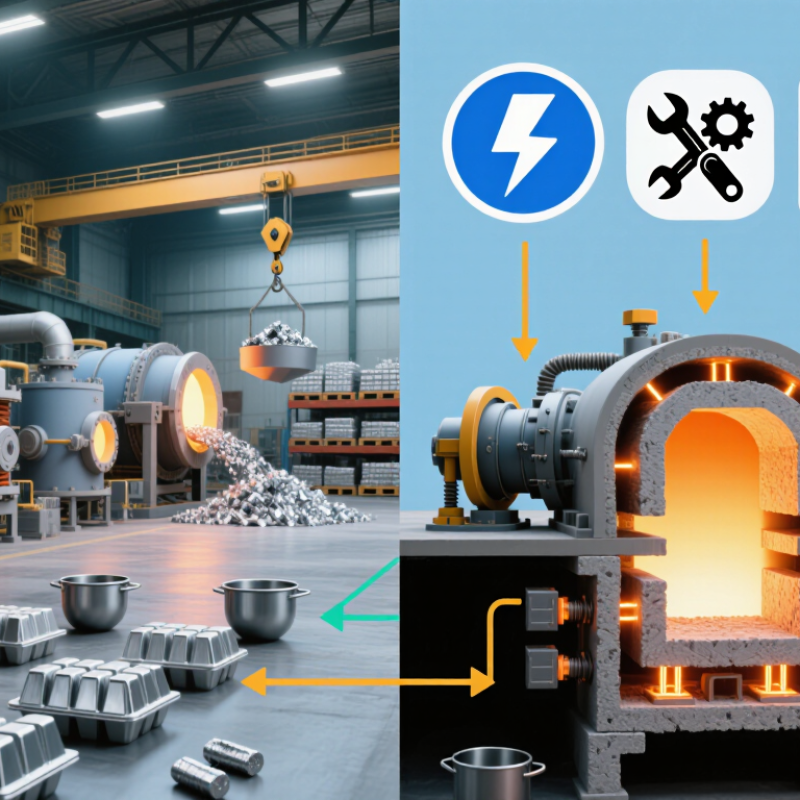
Fuel, electric, induction, and holding furnaces suit different production realities. Gas-fired furnaces remain practical for large batches and heavy crucibles. Their flame heats the chamber directly, but exhaust losses can be significant.
Electric resistance furnaces offer clean, controllable heating and simple temperature programming. They are useful where electricity is stable and emissions at the workshop matter. Induction furnaces heat the metal itself, often achieving fast melting and strong temperature uniformity. They require higher electrical infrastructure and careful coil maintenance.
Holding systems are different. They preserve molten aluminium between batches, reducing repeated melting cycles and oxidation. The International Aluminium Institute states that recycled aluminium requires about 5% of the energy used for primary aluminium production. Efficient holding can help protect that advantage, although electricity still has an environmental cost.
My first instinct was to choose induction. That was too simple.
A furnace should be judged by batch size, alloy change frequency, melt-loss records, energy tariffs, ventilation, and operator experience.
A small foundry may gain more from a well-insulated electric furnace than an oversized induction unit.
Measure the real cycle. Forecasts alone can mislead.
Selection Criteria: Recovery Rates Above 90%, Emissions, Safety, and Cost
How to Choose the Best Aluminium Melting Furnace?
A reliable furnace should target metal recovery above 90%, but this figure needs careful definition. Is recovery measured after melting, or after dross treatment? Clean, dry scrap usually performs better than painted or oily feedstock. In practical audits, weigh the charge, molten output, dross, and residues every shift. Measure it daily.
A 2023 report from the International Aluminium Institute states that recycling aluminium uses about 95% less energy than primary production. However, excessive holding time can increase oxidation and reduce that advantage.
Emissions deserve equal attention. Ask for measured particulate, nitrogen oxide, and volatile organic compound data, not only catalogue estimates. The US EPA AP-42 guidance identifies furnace charging, melting, and dross handling as important emission points.
A furnace with sealed charging, effective extraction, and suitable filtration can improve workplace air quality. Still, one oversized filter does not solve poor airflow design. Operators should also inspect alarms, door interlocks, emergency stops, and molten-metal containment. Safety is measurable.
Cost calculations should include electricity, refractory replacement, maintenance, labour, and metal loss. European Aluminium’s Environmental Profile Report 2022 shows the major carbon advantage of recycled aluminium, yet energy performance varies by feedstock and process control.
A cheaper furnace may look attractive initially. It may become expensive through unstable temperature control and higher dross generation. Request verified operating data from comparable loads, then test the assumptions with a short production trial. A spreadsheet can still mislead.
Article Source:
Request a Quote
Fill out the form below and one of our specialists will contact you to discuss your questions and needs.