Top 10 Thermal Sticker Label Manufacturers Worldwide
Thermal Sticker Label selection looks simple until a roll meets heat, friction, moisture, or a fast-moving printer. A clear product comparison starts with those real conditions, not a manufacturer’s headline claims. This guide introduces ten worldwide manufacturers and the capabilities buyers should examine, including print consistency, adhesive performance, roll dimensions, material options, and production capacity. Small details matter. A label that curls beside a warm packing line can slow an otherwise efficient process.
Label-industry analyst Mike Fairley is a recognized authority on label production, but I cannot verify a direct quotation from him about thermal sticker labels. Rather than invent one, this introduction uses a practical principle: match the label to its environment and intended use. Compare suppliers by testing samples on the actual printer and packaging, then check whether text remains legible after handling. Ask about lead times and customization, too. A polished catalogue is useful, but it cannot prove how a label performs on your line. The comparison ahead is a starting point, not a final verdict; specifications and service can vary by region, order size, and application.
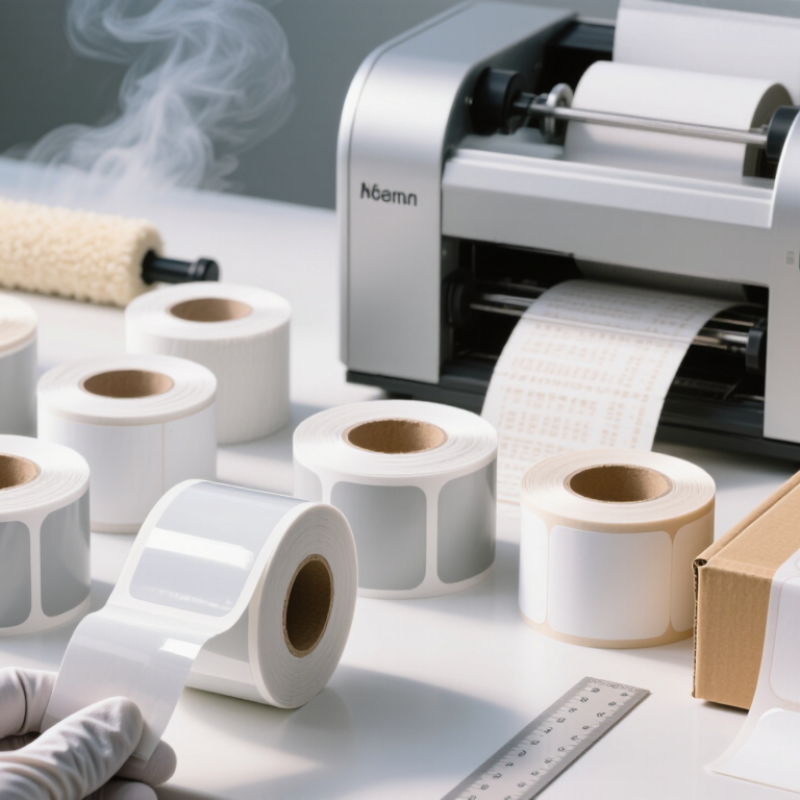
Thermal Sticker Labels Explained: Direct-Thermal and Thermal-Transfer Methods
Thermal sticker labels create images through heat, but the two methods behave differently in daily use. Direct-thermal stock darkens when a heated printhead touches its coated surface. No ribbon is needed. This keeps loading simple at shipping stations and for price tags or short-lived inventory labels. Yet heat, sunlight, and friction can fade or darken the image sooner than expected.
Thermal-transfer printing uses a ribbon between the printhead and label. Heat moves ink from the ribbon onto paper or synthetic face stock, often creating marks with better resistance to abrasion, moisture, and chemicals. Ribbon and label must be compatible. Wax, wax-resin, and resin ribbons suit different surfaces and durability needs. A mismatch can cause weak barcodes, smudging, or unnecessary material costs. Test actual labels.
When evaluating thermal sticker label manufacturers, look beyond a sample roll. Check adhesive performance on cardboard, glass, or curved containers, and review print quality at your intended speed. Direct thermal may suit a parcel label used for days, while transfer printing may be wiser for tracking labels kept for months. Conditions vary. Cold rooms, rough handling, and cleaning agents can change the result. Record storage and use conditions before choosing; a neat bench test cannot fully represent a busy packing line.
Print Resolution Benchmarks: 203, 300, and 600 dpi Across Label Applications
For thermal sticker label manufacturers, print resolution is a practical benchmark, not a quality guarantee. A 203 dpi printhead suits shipping labels, carton IDs, and bold text. Standard barcodes can scan reliably when their size and contrast are appropriate. That is often enough. At 300 dpi, compact text, small product identifiers, and finer graphics tend to look cleaner. This resolution works well for retail and healthcare labels where space is limited.
A 600 dpi printer can reproduce very small characters, thin lines, and intricate symbols. It may be useful for electronics or laboratory labels, but it can cost more and print more slowly. The label material, ribbon choice, print speed, and printhead condition also affect results. A sharp resolution number cannot fix a poorly matched substrate. Some buyers focus too heavily on dpi; real production samples are more revealing.
Tips: Test the smallest text and barcode on the actual label stock. Check scans under ordinary handling and lighting, not only on screen. Compare samples at 203, 300, and 600 dpi when details matter. Keep a little margin in the design; tiny text can still become hard to read.
Top 10 Worldwide Thermal Sticker Label Manufacturers and Their Product Strengths
A comparison of the top 10 thermal sticker label manufacturers is most useful when it focuses on product strengths, not rankings alone. Some suppliers excel at everyday paper labels for shipping and retail. Others offer synthetic face stock that better resists moisture, scuffing, and handling. A few specialize in freezer labels, where adhesive must stay attached to cold packaging. Printer compatibility matters, too. Small details count.
Across the field, strengths can include consistent coating for crisp barcodes, flexible roll sizes, reliable perforation, and custom converting for unusual shapes. Some manufacturers offer adhesive options for cardboard, plastic, or curved containers. Others focus on high-volume production and stable color or print performance across batches. These differences are practical, but a product description cannot replace a sample test. A ranking can flatten real variation. Check print darkness, label feed, adhesion, and performance in the actual storage environment before choosing. One weakness in many comparisons is limited detail about testing conditions, so treat broad performance claims with care.
Supplier Evaluation Using ISO/IEC 15416 Barcode Verification Grades
Top 10 Thermal Sticker Label Manufacturers Worldwide
Supplier Evaluation Using ISO/IEC 15416 Barcode Verification Grades
For thermal sticker labels, a barcode that looks dark and sharp may still scan poorly. ISO/IEC 15416 provides a repeatable method for grading printed linear barcodes. A verifier measures features such as symbol contrast, edge contrast, defects, and modulation. Results are reported on a 0.0–4.0 scale, often alongside letter grades from F to A.
Ask each supplier for verification reports made with a calibrated verifier, not a phone app or an ordinary scanner. Check the tested label material, print method, ribbon, and production settings. These details matter: a sample printed on smooth stock may grade differently from a roll used on a cold warehouse line. Request results from several labels across a production run, and compare them against your own minimum grade and scanning conditions.
Look closely at the report. A single passing score can hide uneven print quality. Still, one test is not enough. Barcode grades do not measure adhesive performance, moisture resistance, or readability after abrasion. Those need separate checks. Supplier comparisons can also be imperfect when test setups differ; document the verifier settings and label batch before drawing conclusions. A clear record makes supplier claims easier to assess, even if it cannot predict every real-world failure.
Industry Uses and Standards: GS1 Barcodes in Retail, Logistics, and Healthcare
Thermal sticker labels turn product data into readable, scannable records across retail and logistics. GS1’s General Specifications define barcode structure, placement, and quality requirements, helping scanners interpret the same identifiers across different systems. GS1 reports that its barcodes are scanned more than 10 billion times each day worldwide. At checkout, a crisp black code on a matte white label can speed identification. In warehouses, durable labels help track cartons through receiving, sorting, and dispatch. Small print matters.
Thermal label selection affects scan reliability. Direct thermal labels suit short-lived shipping and shelf labels, while thermal transfer labels often resist heat, moisture, and abrasion better. The GS1 Logistic Label Guideline describes how shipment identifiers and barcodes support handling-unit tracking. Yet rushed application can leave codes wrinkled or hidden on a box seam. The standard cannot fix that.
Healthcare demands careful identification, too. In a 2010 New England Journal of Medicine study, barcode medication administration was associated with a 41.4% reduction in nontiming administration errors. Labels must remain legible through storage and routine handling. A clean scan helps. It is not a substitute for staff checks, and the evidence does not make every workflow safer by itself. Thermal label manufacturers should validate print contrast, adhesive performance, and barcode readability under real operating conditions. A test sheet is useful, but a busy clinic is different.
GS1 GTIN Formats on Thermal Labels
GTIN formats contain 8, 12, 13, or 14 digits. GTIN-8 is intended for small items; GTIN-12 and GTIN-13 are used in retail contexts, while GTIN-14 is commonly used for cases and other packaging levels. The chart compares identifier lengths, not market share or adoption rates. Thermal printing is a label production method; the appropriate barcode and identifier depend on the item and application.